
Theory
Maximum Power Transfer Theorem
Maximum Power Transfer Theorem explains that to generate maximum external power through a finite internal resistance (DC network), the resistance of the given load must be equal to the resistance of the available source.
Proof of Maximum Power Transfer Theorem
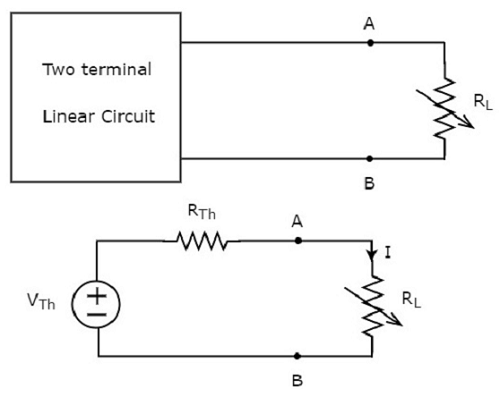
Replace any two terminal linear network or circuit to the left side of variable load resistor having resistance of RL ohms with a Thevenin’s equivalent circuit. We know that Thevenin’s equivalent circuit resembles a practical voltage source.
This concept is illustrated in following figures.
The amount of power dissipated across the load resistor is
PL = I 2 R L
Substitute I = VTh / R Th + RL
in the above equation.
PL = ⟮ VTh / (R Th + RL )⟯ 2 R L
⇒PL = VTh2 { RL / ( RTh + RL ) 2 } Equation 1
Condition for Maximum Power Transfer
For maximum or minimum, first derivative will be zero. So, differentiate Equation 1 with respect to RL and make it equal to zero.
dPL / dRL = VTh2{ ( RTh + RL )2× 1 − RL × 2 ( RTh + RL ) / ( RTh + RL )4} = 0
⇒ ( RTh + RL ) 2 − 2RL ( RTh + RL ) = 0
⇒ ( RTh + RL) ( RTh + RL − 2RL ) = 0
⇒ ( RTh − RL ) = 0
⇒ RTh = RL or RL = RTh
Therefore, the condition for maximum power dissipation across the load is
RL = R Th
That means, if the value of load resistance is equal to the value of source resistance i.e., Thevenin’s resistance, then the power dissipated across the load will be of maximum value.