
Introduction
The operating system acts as an interface between the software and hardware components. It is designed to manage all the resources and operations of the computer. It controls and monitors the execution of all other programs running on the computer. Some examples of operating systems include Windows, Linux, and macOS. The operating system is essential for making an application user-friendly. Every application on the system requires an operating system. It is present in every device, whether large or small, and helps make the application more accessible. The operating system is a fully integrated set of specialized programs that handles all operations of the computer.
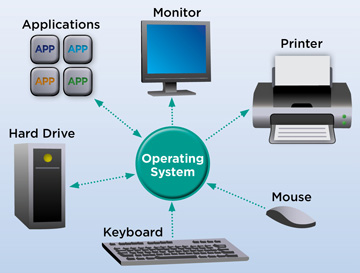
The operating system has been evolving through the years. The following table shows the history of OS.
| Generation | Year | Electronic devices used | Types of OS and devices |
|---|---|---|---|
| First | 1945-55 | Vacuum Tubes | Plug Boards |
| Second | 1955-65 | Transistors | Batch Systems |
| Third | 1965-80 | Integrated Circuit (ICs) | Multiprogramming |
| Fourth | Since 1980 | Large Scale Integration (LSI) | Personal Computers (PC) |
Types of Operating System
There are several types of Operating Systems which are mentioned below:
- Batch operating system
- Multi-programming operating system
- Time sharing operating system
- Real time operating system
- Network operating system
Characteristics
- Error-detecting Aids : These contain methods that includes the production of dumps, traces, error messages and other debugging and error correcting methods.
- Job accounting : It keeps track of the time and resources used by various job and users.
- Security : It prevents unauthorized access to programs and data using passwords or some kind of protection techniques.
- Convenience : An OS makes a computer more convenient to use.
- Efficiency : An OS allows the computer to use the resources more efficiently.
- Throughput : An OS should be constructed such that it gives maximum throughput.
Functionalities
- Process management : Manages the execution of processes, determining which process runs at any given time.
- File management : Manages how files are stored, retrieved, and organized on storage devices.
- Device management : Manages input and output operations, optimizing access to hardware resources.
- Resource allocation : Allocates CPU time to processes based on scheduling algorithms.
- System services : Provides a set of system calls that allow user applications to interact with the OS.
- Networking : Provides services like file sharing, printing over a network, and remote access.
Advantages
- Multitasking : It has the ability to execute multiple tasks at a time and users do not have to wait for one task to finish to start the another task.
- No coding lines : The rise of graphical user interface has eliminated the process of writing complex commands for the small tasks.
- Data protection : Data is generated and stored in the system on a very large scale. All this data is accessed through operating system and has smooth accessibility. It also has strong security features to handle the data smoothly. This process can be initiated in various ways which includes username and password, biometric verification and authentication.
- Resource sharing : Data can be shared seamlessly with several devices and multiple users. It makes the sharing of data and information more flexible and smooth.
- User friendly : It made the graphical user interface more user friendly as it contains different graphical representations, icons, symbols and buttons.
- Computing source : It acts as an interface between user and computer's hardware. It helps in effective communication between user and computer systems to improve the performance of any task. Complex tasks can be performed easily if user can communicate well with the system.
Disadvantages
- System failure : Operating system is considered to be the heart of the operating system. With the crash operating system, no functions, tasks and commands will be executed. There are high chances of data to be lost completely.
- Expensive : Operating system like Windows and Mac are very expensive compared to other operating systems like Linux.
- Virus threats : Operating System is vulnerable to external threats as user can unknowingly download a malicious file.
- Reliability : The question of reliability is raised whenever there are any issues or failure in the system.