Theory
Inheritance is an important pillar of OOP(Object Oriented Programming). It is the mechanism in java by which one class is allow to inherit the features(fields and methods) of another class.
Why And When To Use "Inheritance"?
- It is useful for code reusability: reuse attributes and methods of an existing class when you create a new class.
Important terminology:
• Super Class: The class whose features are inherited is known as super class(or a base class or a parent class).
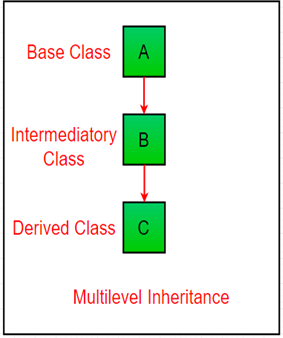
• Sub Class: The class that inherits the other class is known as sub class(or a derived class, extended class, or child class). The subclass can add its own fields and methods in addition to the superclass fields and methods.• Reusability: Inheritance supports the concept of “reusability”, i.e. when we want to create a new class and there is already a class that includes some of the code that we want, we can derive our new class from the existing class. By doing this, we are reusing the fields and methods of the existing class.Types of Inheritance in JavaBelow are the different types of inheritance which is supported by Java.1. Single Inheritance : In single inheritance, subclasses inherit the features of one superclass. In image below, the class A serves as a base class for the derived class B.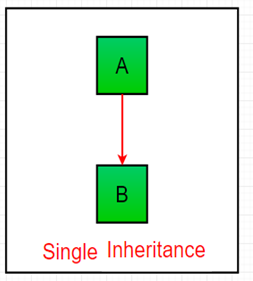 2. Multilevel Inheritance : In Multilevel Inheritance, a derived class will be inheriting a base class and as well as the derived class also act as the base class to other class. In below image, the class A serves as a base class for the derived class B, which in turn serves as a base class for the derived class C. In Java, a class cannot directly access the grandparent’s members.
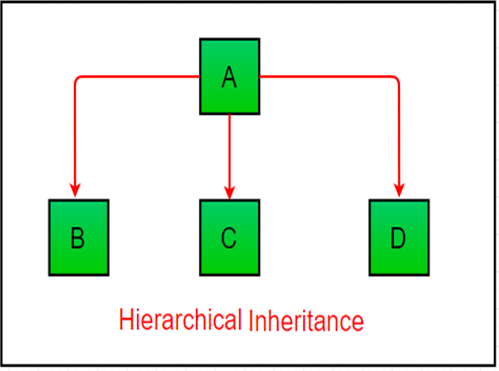
 3. Hierarchical Inheritance : In Hierarchical Inheritance, one class serves as a superclass (base class) for more than one sub class.In below image, the class A serves as a base class for the derived class B,C and D.
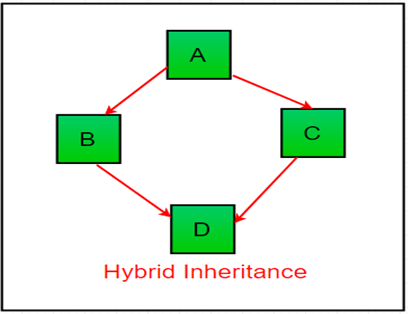
 5. Hybrid Inheritance(Through Interfaces) : It is a mix of two or more of the above types of inheritance. Since java doesn’t support multiple inheritance with classes, the hybrid inheritance is also not possible with classes. In java, we can achieve hybrid inheritance only through Interfaces.
  Important facts about inheritance in Java - • Default superclass: Except Object class, which has no superclass, every class has one and only one direct superclass (single inheritance). In the absence of any & other explicit superclass, every class is implicitly a subclass of Object class. • Superclass can only be one: A superclass can have any number of subclasses. But a subclass can have only one superclass. This is because Java does not support multiple inheritance with classes. Although with interfaces, multiple inheritance is supported by java. • Inheriting Constructors: A subclass inherits all the members (fields, methods, and nested classes) from its superclass. Constructors are not members, so they are not inherited by subclasses, but the constructor of the superclass can be invoked from the subclass. • Private member inheritance: A subclass does not inherit the private members of its parent class. However, if the superclass has public or protected methods (like getters and setters) for accessing its private fields, these can also be used by the subclass.