
Theory
Introduction Ultrasonic sensor:
In the realm of modern technology, ultrasonic sensors stand as beacons of innovation, offering a symphony of precision and perception. Harnessing sound waves beyond human hearing, these marvels detect objects, measure distances, and navigate environments with unparalleled accuracy. Their non-contact sensing capabilities transcend traditional limitations, operating in adverse conditions where optical sensors falter. From industrial automation to everyday gadgets, ultrasonic sensors play pivotal roles, seamlessly integrating into diverse applications.
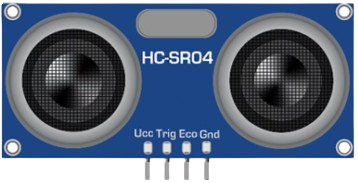
What is an Ultrasonic Sensor?
Ultrasonic sensors are sophisticated devices that utilize sound waves of frequencies higher than the audible range of humans to detect the presence, distance, and even composition of objects. They are like high-tech ears for machines. They use sound waves that are too high for humans to hear to figure out what's around them. These sensors can tell if something is there, how far away it is, and even what it's made of. They're super important for making machines smart and helping them understand the world around them really well. It's like giving them a special sense that lets them navigate, avoid obstacles, and do all sorts of cool stuff with incredible accuracy. Without ultrasonic sensors, many automated systems wouldn't be able to do their jobs nearly as well.
HC-SR04 Ultrasonic sensor:
The HC-SR04 ultrasonic sensor is a popular and versatile component used for distance measurement and object detection in various electronic projects. It consists of two main components: an ultrasonic transmitter and receiver. The sensor operates by emitting ultrasonic pulses from the transmitter and measuring the time it takes for the pulses to bounce off an object and return to the receiver. Key features of the HC-SR04 sensor include:
1. High Accuracy: The sensor provides accurate distance measurements with a resolution of up to 3mm.
2. Wide Detection Range: It can detect objects within a range of 2cm to 400cm, making it suitable for both short-range and long-range applications.
3. Easy Interface: The HC-SR04 sensor is easy to interface with microcontrollers such as Arduino, Raspberry Pi, and other development boards. It requires only four pins for connection: VCC (power supply), GND (ground), Trig (trigger), and Echo (echo signal).
4. Fast Response Time: The sensor operates with a high-speed response time, enabling real-time object detection and distance measurement.
5. Low Power Consumption: It consumes minimal power, making it suitable for battery-powered applications. Typically it operates at a working voltage of 5V DC.
6. Affordability: The HC-SR04 sensor is cost-effective and widely available, making it a popular choice for hobbyists, students, and professionals alike.
Working principle of Ultrasonic sensor:
Ultrasonic sensors operate on a fascinating principle that involves converting electrical energy into sound waves and back again. At the core of these sensors lies a component called a transducer, which acts as both a speaker and a microphone. When the sensor is triggered, it sends out bursts of ultrasonic pulses, similar to how a bat emits sonar waves. These pulses travel through the air until they encounter an object in their path. Upon reaching an object, some of the ultrasonic pulses are absorbed, while others bounce back towards the sensor, much like an echo bouncing off a wall. The sensor's transducer then switches from emitting pulses to listening mode, where it captures the returning echo
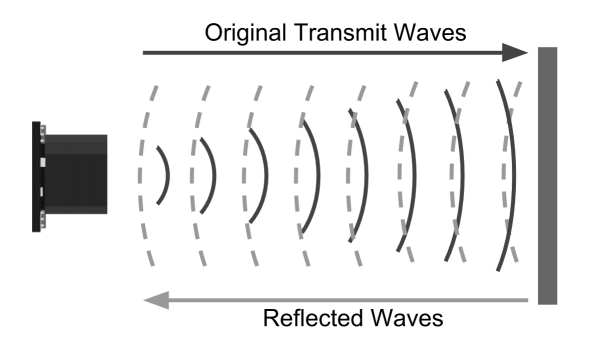
By precisely measuring the time it takes for these echoes to return to the sensor, the device can calculate the distance to the object. This calculation relies on the speed of sound in the air, which is constant under normal conditions. Since the speed of sound is known, the sensor can accurately determine how far away the object is based on the time it takes for the ultrasonic pulses to travel to the object and back. What makes ultrasonic sensors particularly remarkable is their exceptional precision in distance measurement. By accurately timing the round-trip journey of the ultrasonic pulses, these sensors can determine distances down to the millimeter level. This level of precision enables them to provide reliable and accurate feedback, crucial for applications ranging from robotics and automation to safety systems in vehicles.
Components and construction of Ultrasonic sensor:
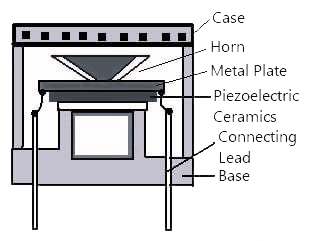
Ultrasonic sensors are comprised of intricate components meticulously assembled to enable their remarkable functionality. At the heart of these sensors lies the transducer, a piezoelectric crystal housed within a protective casing. This transducer serves as both emitter and receiver, converting electrical energy into ultrasonic waves and vice versa. Supporting the transducer are the driver and receiver circuits, responsible for generating ultrasonic pulses and amplifying and processing returning echoes, respectively. Control electronics, often including microcontrollers or dedicated ICs, orchestrate the sensor's operation, from triggering pulses to interpreting received signals. Signal processing units refine the captured data, filtering noise and calculating distances based on time-of-flight principles. An output interface communicates measurements to external devices, while a stable power supply ensures continuous operation. Through meticulous construction and integration of these components, ultrasonic sensors deliver unparalleled precision and reliability in distance measurement and object detection across various applications and industries.
Types of Ultrasonic sensor:
Ultrasonic sensors come in various types, each tailored to specific applications and environments. Here's a detailed description of the main types:
1. Proximity Sensors: These sensors detect the presence of objects within a certain range without making physical contact. They emit ultrasonic waves and measure the time it takes for the waves to reflect back from nearby objects. Proximity sensors are commonly used in robotics, automation, and security systems for obstacle detection and object avoidance.
2. Distance Measurement Sensors: Unlike proximity sensors, distance measurement sensors provide precise distance measurements to objects within their detection range. They calculate distances based on the time it takes for ultrasonic waves to travel to the object and back. These sensors are widely used in industrial automation, automotive applications (such as parking assistance systems), and smart devices.
3. Level Sensors: Level sensors utilize ultrasonic technology to measure the level of liquid or solid substances in tanks, containers, or silos. They emit ultrasonic pulses toward the surface of the material and measure the time it takes for the pulses to reflect back. Level sensors are commonly employed in industries such as manufacturing, agriculture, and wastewater management for monitoring and control purposes.
4. Object Detection Sensors: These sensors are designed to detect the presence or absence of specific objects within their detection range. They emit ultrasonic waves and analyze the returning echoes to determine the presence and characteristics of objects. Object detection sensors find applications in conveyor systems, packaging, and material handling equipment, enhancing efficiency and safety in industrial settings.
5. Ultrasonic Rangefinders: Rangefinders are specialized ultrasonic sensors used for outdoor applications such as measuring distances between objects over longer ranges. They emit narrow ultrasonic beams and measure the time it takes for the beams to reflect back from distant objects. Ultrasonic rangefinders are commonly utilized in robotics, navigation systems, and geographic mapping.
6. Flow Sensors: Ultrasonic flow sensors utilize the Doppler effect or transit time principle to measure the flow rate of liquids or gases in pipes or ducts. They emit ultrasonic waves into the flowing medium and analyze the frequency shift or time delay caused by the motion of particles within the medium. Ultrasonic flow sensors are crucial for various industries, including HVAC, water management, and energy production.
Applications of the Ultrasonic sensors:
Ultrasonic sensors offer unparalleled versatility and reliability, making them indispensable across a wide range of applications in industries such as automotive, manufacturing, aerospace, and agriculture. Here's an elaboration on some of the key areas where Ultrasonic sensors play a vital role:
1. Distance Measurement: Ultrasonic sensors excel in accurately measuring distances, making them invaluable in applications such as parking assistance systems in cars. By emitting ultrasonic pulses and calculating the time it takes for them to bounce back from nearby obstacles, these sensors provide drivers with real-time feedback on their proximity to objects, enhancing safety and maneuverability. Additionally, in industrial settings, ultrasonic sensors are utilized for level sensing in tanks and containers, ensuring precise monitoring of fluid levels for efficient operations and preventing overflows or shortages.
2. Obstacle Detection: Robotics and drones rely on ultrasonic sensors to navigate complex environments with agility and safety. By constantly emitting and receiving ultrasonic pulses, these sensors enable robots and drones to detect obstacles in their path and adjust their trajectory accordingly, avoiding collisions and ensuring smooth operation. Whether navigating indoors or outdoors, ultrasonic sensors provide reliable obstacle detection capabilities, allowing autonomous systems to perform tasks efficiently and autonomously.
3. Fluid Level Monitoring: Ultrasonic sensors play a crucial role in industrial settings by monitoring fluid levels in tanks and containers. By emitting ultrasonic pulses and measuring the time it takes for them to reflect back from the surface of the fluid, these sensors provide accurate and real-time information about fluid levels. This ensures optimal utilization of resources, prevents spills or leaks, and facilitates timely maintenance and refilling of tanks, contributing to smooth operations and cost efficiency in various industries such as chemical processing, water treatment, and oil and gas.
4. Object Detection: Ultrasonic sensors are widely deployed in conveyor systems to detect the presence or absence of objects on the conveyor belt. By emitting ultrasonic pulses and analyzing the echoes reflected back from objects, these sensors enable precise detection and tracking of items as they move along the conveyor line. This enhances the efficiency of manufacturing processes by facilitating automated sorting, packaging, and quality control operations, minimizing errors and maximizing productivity.
Circuit for Interfacing of the Ultrasonic sensors with Arduino:
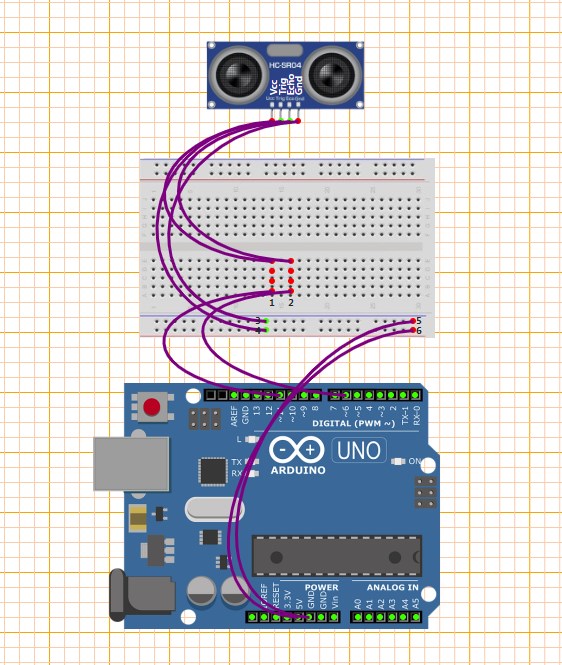
Working of the Circuit:
1. In the setup() function:
• pinMode(trig_pin, OUTPUT);
configures the trig_pin (connected to the trigger pin of the ultrasonic sensor) as an output pin, allowing it to send signals.
• pinMode(Echo_pin, INPUT);
configures the Echo_pin (connected to the echo pin of the ultrasonic sensor) as an input pin, allowing it to receive signals from the sensor.
• Serial.begin(9600);
initializes serial communication with a baud rate of 9600 bits per second, enabling communication with the serial monitor.
2. In the loop() function:
• digitalWrite(trig_pin, LOW);
ensures the trig_pin is initially low.
• delayMicroseconds(2);
delays for 2 microseconds.
• digitalWrite(trig_pin, HIGH);
sends a 10 microsecond pulse to the trig_pin to trigger the ultrasonic sensor.
• delayMicroseconds(10);
delays for 10 microseconds.
• digitalWrite(trig_pin, LOW);
stops the trigger pulse.
• duration = pulseIn(Echo_pin, HIGH);
measures the duration of the pulse received by the Echo_pin.
• distance = duration * 0.034 / 2;
calculates the distance based on the duration of the pulse (speed of sound is approximately 34 cm/ms, hence divided by 2 for round-trip distance).
Therefore, this Arduino code implements a continuous distance measurement system using an ultrasonic sensor. Upon initialization, it configures the necessary pins for communication with the sensor and sets up serial communication for output to the serial monitor. Within the main loop, it triggers the ultrasonic sensor by sending a brief pulse through the trigger pin and measures the duration it takes for the echo signal to return. This duration is converted into distance using the known speed of sound, providing an accurate measurement of the distance from the sensor to the nearest object. The calculated distance is then printed to the serial monitor for real-time monitoring and analysis. This system enables users to accurately monitor changes in proximity, making it suitable for applications such as intrusion detection or obstacle avoidance.