
Theory
Introduction:
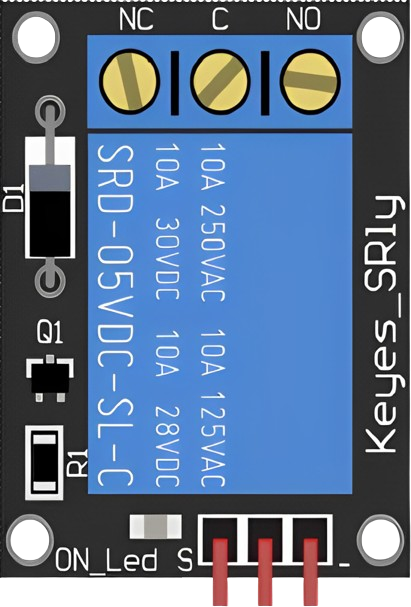
Relays are electrically operated switches that open and close the circuits by receiving electrical signals from outside sources. Some people may associate “relay” with a racing competition where members of the team take turns passing batons to complete the race.
The “relays” embedded in electrical products work in a similar way; they receive an electrical signal and send the signal to other equipment by turning the switch on and off.
For example, when you push the button on a TV remote to watch TV, it sends an electrical signal to the “relay” inside the TV, turning the main power ON. There are various types of relays used in many applications to control different amounts of currents and number of circuits.
The heart of a relay is an electromagnet (a coil of wire that becomes a temporary magnet when electricity flows through it). You can think of a relay as a kind of electric lever: switch it on with a tiny current and it switches on ("leverages") another appliance using a much bigger current. Why is that useful? As the name suggests, many sensors are incredibly sensitive pieces of electronic equipment and produce only small electric currents. But often we need them to drive bigger pieces of apparatus that use bigger currents. Relays bridge the gap, making it possible for small currents to activate larger ones. That means relays can work either as switches (turning things on and off) or as amplifiers (converting small currents into larger ones).
Different Types of Relays:
Depending on the operating principle and structural features relays are of different types such as electromagnetic relays, thermal relays, power varied relays, multi-dimensional relays, and so on, with varied ratings, sizes, and applications. Classification or the types of relays depend on the function for which they are used.
Some of the categories include protective, reclosing, regulating, auxiliary and monitoring relays. Protective relays continuously monitor these parameters: voltage, current, and power; and if these parameters violate set limits they generate an alarm or isolate that particular circuit. These types of relays are used to protect equipment like motors, generators, and transformers, and so on.
In general, relays classification is dependent on the electric capacity which is activated by current, power, voltage, and many other quantities. Classification is based on the mechanical capacity activated by the speed of gas or liquid outflow, pressure. Whereas based on thermal capacity activated by heating power, and the other quantities are acoustical, optical, and others.
Different Types of Relays in Electromagnetic Types:
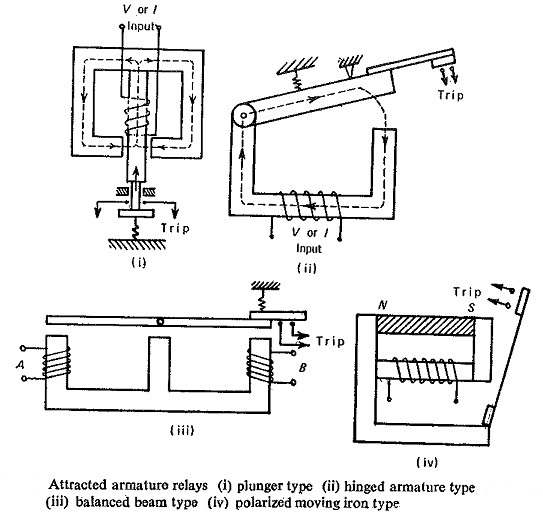
These relays are constructed with electrical, mechanical, and magnetic components, and have operating coil and mechanical contacts. Therefore, when the coil gets activated by a supply system, these mechanical contacts get opened or closed. The type of supply can be AC or DC. These electromagnetic relays are further classified as:
i) DC and AC relays
ii) Attraction type
iii) Induction type
Working Principle of Relays:
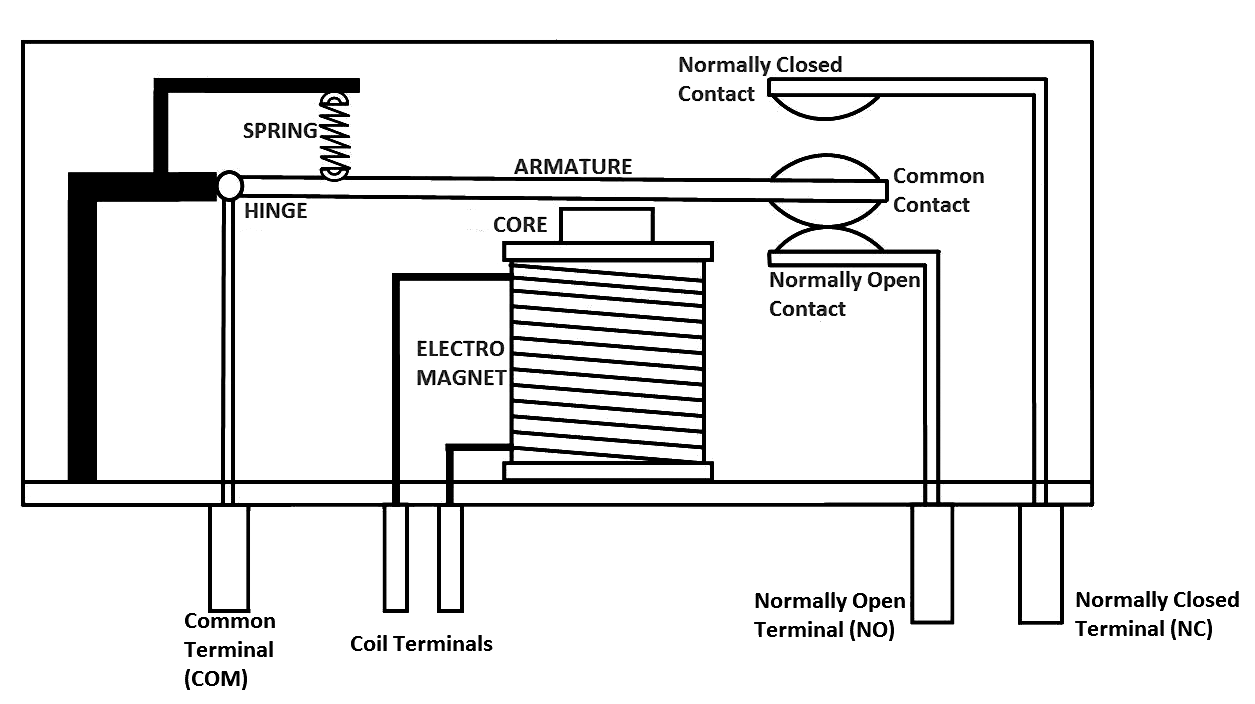
Relays work as electrical switches that you can control remotely. Inside a relay, there's a coil that, when electricity flows through it, creates a magnetic field. This field attracts or repels a switch, either closing or opening it. It's like flipping a regular switch, but with the power of magnetism.
The fascinating part about relays is how they keep things safe. They have separate sections for the control part (where the coil is) and the main part (where the switch controls the flow of electricity). This separation prevents any mishaps and ensures smooth operation.
Relays are incredibly versatile. They can take a small signal, like a button press or a sensor reading, and use it to control much bigger things, like motors or heaters. That's why you see them everywhere, from home appliances to industrial machinery to automotive systems, making automation and control possible.
Components of Relays:
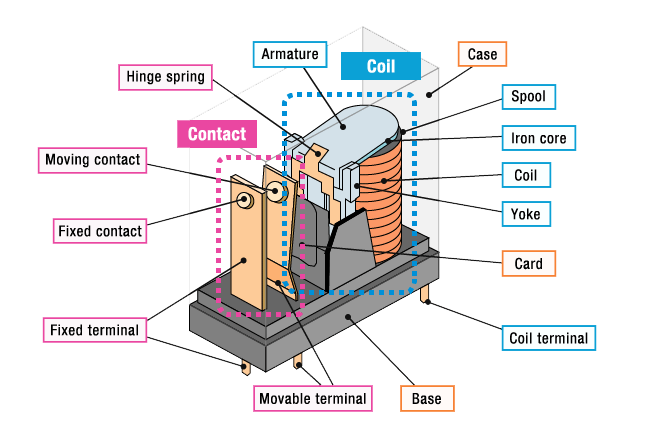
The components of a relay typically include:
1. Coil: The coil is an electromagnet that creates a magnetic field when energized by an electrical current. The coil is typically made of wire wound around a core, such as a bobbin or a core made of a ferromagnetic material.
2. Contacts: The contacts are the electrical terminals that control the flow of electricity through the circuit. Contacts can be normally open (NO) or normally closed (NC), or changeover (CO) depending on the design of the relay.
3. Armature or Mover: The armature is the part of the relay that is attracted to the coil’s magnetic field and moves the contacts.
4. Yoke: The yoke is a metal frame that surrounds the coil and provides a path for the magnetic field.
5. Core: The core is part of the coil and acts as a magnetic path.
6. Housing: The housing is the outer shell of the relay that protects the internal components.
7. Terminal: The terminal is a place where the relay connects to the circuit.
8. Spring: Spring is used to hold the contacts in a certain position or to return the armature back to its original position.
9. Diode: Some relays have a diode to protect the coil from high voltage spikes caused when the contacts open.
Some relays may have additional components, such as a mechanism to hold the armature in place, an indicator light, and/or additional protective devices, depending on the relay design and its application.
Applications of Relays:
Relays find applications in various fields due to their versatility in controlling electrical circuits. Some common applications include:
1. Home Automation:
Relays are used in smart home systems to control lights, fans, and other appliances remotely via smartphones or voice commands.
2. Industrial Automation:
In factories and manufacturing plants, relays are employed to control machinery, conveyor belts, and production lines. They help automate processes and improve efficiency.
3. HVAC Systems:
Heating, ventilation, and air conditioning (HVAC) systems utilize relays to control heating elements, fans, and compressor motors, enabling precise temperature regulation in buildings.
4. Automotive Electronics:
Relays play a crucial role in automotive systems, controlling functions such as starter motors, headlights, windshield wipers, and fuel pumps. They ensure reliable operation of various electrical components in vehicles.
5. Power Distribution:
Relays are used in power distribution systems to control the flow of electricity, switch between different power sources, and protect circuits from overloads or faults.
6. Security Systems:
Relays are integrated into security systems to activate alarms, door locks, and surveillance cameras in response to sensor inputs such as motion detection or door/window opening.
7. Telecommunications:
In telecommunications networks, relays are used to switch between different communication channels, route signals, and ensure seamless connectivity in data transmission systems.
8. Medical Equipment:
Relays are utilized in medical devices and equipment to control pumps, valves, and motors, facilitating the precise delivery of medications, fluids, and diagnostic procedures.
9. Renewable Energy Systems:
Relays play a role in renewable energy systems such as solar panels and wind turbines, controlling the charging of batteries, switching between power sources, and managing power distribution within the system.
10. Appliance Control:
Relays are integrated into household appliances such as refrigerators, washing machines, and microwave ovens to control motors, heating elements, and other functional components.
These are just a few examples of the wide-ranging applications of relays across various industries and sectors, highlighting their importance in modern electrical and electronic systems.
Circuit for Interfacing of the Relay with Arduino:
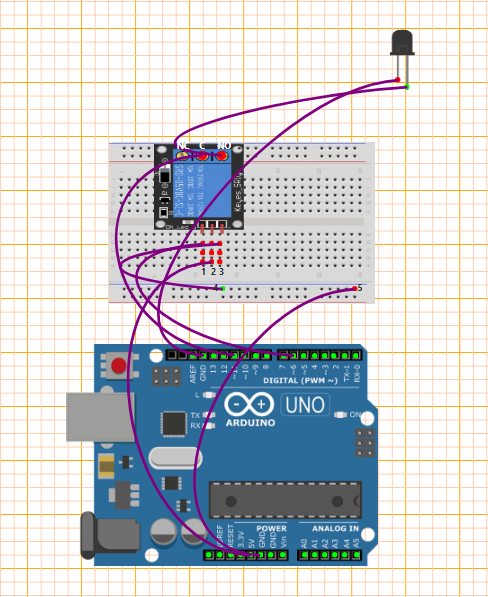
Working of the Circuit:
1. Variable Declaration:
- relay_pin is defined to specify the digital pin connected to the relay module.
- led_pin is defined to specify the digital pin connected to an LED for visual indication.
2. In the Setup Function:
• pinMode(relay_pin, OUTPUT);
configures the relay_pin as an output pin, allowing the Arduino to control the relay module.
• pinMode(led_pin, OUTPUT);
configures the led_pin as an output pin to control an LED (optional).
• digitalWrite(led_pin, HIGH);
turns on an LED connected to led_pin to indicate that the system is powered up (optional).
3. In the Loop Function:
• digitalWrite(relay_pin, HIGH);
sets the relay_pin to a HIGH state, turning on the relay and activating the connected device (e.g., motor).
• delay(1500);
introduces a delay of 1500 milliseconds (1.5 seconds), during which the device remains activated.
• digitalWrite(relay_pin, LOW);
sets the relay_pin to a LOW state, turning off the relay and deactivating the connected device.
• delay(1500);
introduces another delay of 1500 milliseconds before the loop repeats.
Therefore, this Arduino code effectively controls a device connected to the relay by toggling the relay on and off at regular intervals specified by the delay duration. This setup can be used for various applications requiring the switching of high-power devices such as motors, lights, heaters, etc., using an Arduino microcontroller. The optional LED can provide visual feedback indicating the status of the system.