
Theory
Introduction:
Photoresistors are analog sensors that can measure light. They are light dependent resistors that change resistance with the amount of light that hits the sensor. Photoresistors are perfect for making light controlled switches. One common application of photoresistors is to control 5 volt relays to switch on a light bulb when it gets dark. They are also used to track daylight in weather stations and environmental monitoring systems.
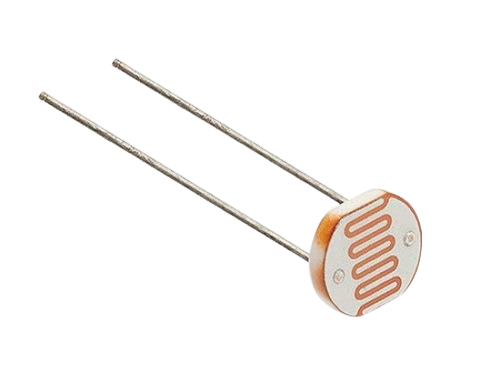
LDR Sensor:
Light Dependent Resistors (LDRs) are semiconductor devices that change their electrical resistance in response to light intensity, a property known as photoconductivity. This enables LDRs to serve as sensitive light sensors in various applications. When exposed to light, more photons hitting the LDR's surface result in increased electron excitation, reducing resistance. Conversely, decreased light intensity leads to increased resistance. LDRs are essential for detecting subtle changes in ambient light levels, making them valuable in applications requiring precise light measurement or control. They are widely used in automatic street lighting systems, where they activate lights at dusk and deactivate them at dawn based on detected light levels. Additionally, LDRs find applications in security systems, environmental monitoring devices, electronic gadgets, and industrial automation systems, enabling accurate light detection and control in diverse settings.
Composition and Construction of LDR:
Light Dependent Resistors (LDRs) are crafted from materials like Cadmium Sulphides, lead sulfide, or cadmium selenide, prized for their photoconductivity. This unique property enables LDRs to dynamically adjust their electrical resistance in response to changes in light intensity. To optimize sensitivity further, LDRs are often intricately shaped into a zigzag pattern, maximizing the surface area exposed to incident light. This design enhancement enhances the LDR's ability to detect even the subtlest fluctuations in illumination. Moreover, the zigzag configuration ensures uniform light exposure across the entirety of the resistor, guaranteeing consistent and reliable performance. To facilitate seamless electrical integration, metal contacts are strategically positioned at both ends of the zigzag shape. These contacts act as terminals, facilitating the transmission of electrical signals to and from the LDR within electronic circuits and systems. Through meticulous design and construction, LDRs harness the photoconductivity of semiconductor materials to achieve heightened sensitivity to light. This enables their widespread application as versatile light sensors across various electronic devices and systems, ranging from automatic lighting controls to environmental monitoring systems.
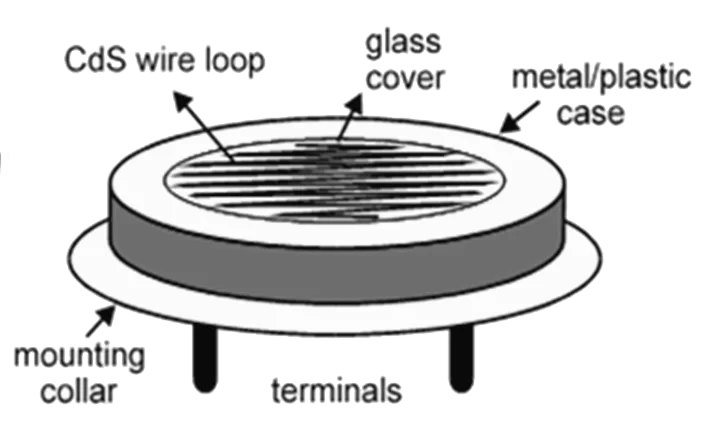
Working Principle of LDR:
Light Dependent Resistors (LDRs) operate based on the principle of photoconductivity, a fundamental property of certain semiconductor materials. When photons, which are packets of light energy, strike the surface of the semiconductor material within the LDR, they transfer their energy to the electrons present in the material. This energy absorption excites the electrons, causing them to transition from the valence band to the conduction band, where they can move more freely. As a result of this electron excitation, the semiconductor material becomes more conductive, allowing electric current to flow more easily through it.
The movement of electrons from the valence band to the conduction band effectively decreases the resistance of the semiconductor material. This reduction in resistance is a direct consequence of the increased conductivity brought about by the excited electrons. Essentially, the LDR becomes more conductive when exposed to light due to the energized electrons facilitating the flow of electric current.
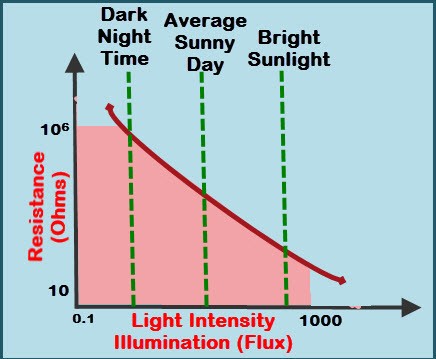
The degree of resistance change in an LDR depends on the intensity of the incident light. Higher light intensities result in greater numbers of photons striking the LDR's surface, thereby exciting more electrons and leading to a more pronounced reduction in resistance. Conversely, lower light intensities lead to fewer excited electrons and a lesser decrease in resistance. This relationship between light intensity and resistance change allows LDRs to accurately reflect changes in ambient light levels and make them highly effective for light sensing applications.
Types of LDR Sensors:
Light Dependent Resistors (LDRs) are available in two main types: Intrinsic and Extrinsic, each offering unique characteristics and applications.
Intrinsic LDRs:
These LDRs are crafted from pure semiconductor materials without any additional impurities. As a result, they exhibit sensitivity across a broad spectrum of light wavelengths. Intrinsic LDRs are renowned for their versatility and general-purpose functionality. Their sensitivity to a wide range of light wavelengths makes them suitable for applications where broad-spectrum light detection is required. These applications may include ambient light sensing in indoor environments, outdoor light monitoring, and general-purpose light control systems.
Extrinsic LDRs:
In contrast, Extrinsic LDRs incorporate impurities into the semiconductor material during the manufacturing process. These impurities modify the material's properties, including its sensitivity to specific light wavelengths. As a result, Extrinsic LDRs are tailored to detect light within specific spectral ranges, making them highly suitable for applications requiring precise light detection in targeted wavelengths. For example, Extrinsic LDRs are often employed in applications involving infrared (IR) light detection, such as remote controls, security systems, and optical communication devices. By focusing their sensitivity on specific wavelengths, Extrinsic LDRs offer enhanced performance and accuracy in specialized light sensing applications.
Applications of LDR:
Light Dependent Resistors (LDRs) have a multitude of applications across different industries due to their sensitivity to light levels and their ability to modulate resistance accordingly.
1. Automatic Lighting Systems:
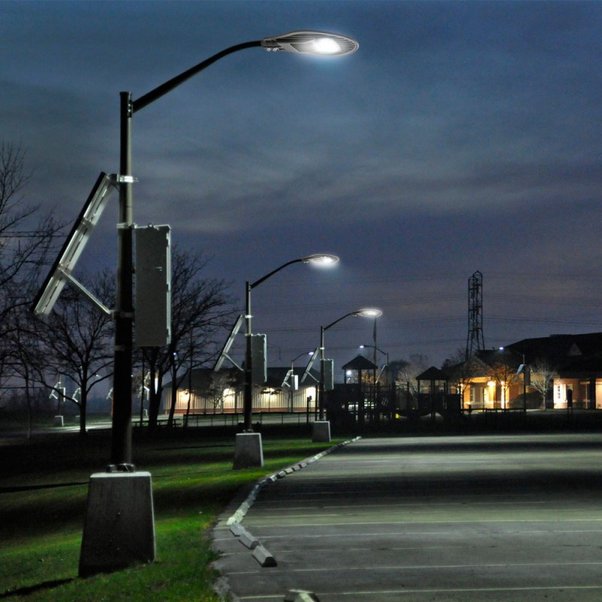
LDRs are integral components in automatic lighting systems, such as streetlights and outdoor security lights. They detect changes in ambient light levels and trigger the activation or deactivation of lighting fixtures accordingly, enhancing energy efficiency and safety.
2. Light-Sensitive Alarms:
LDRs are employed in light-sensitive alarm systems, where they detect variations in light intensity caused by intruders or unauthorized entry. When the light level changes beyond a predefined threshold, the alarm system is activated, alerting occupants or authorities.
3. Environmental Monitoring Devices:
LDRs play a crucial role in environmental monitoring devices, such as weather stations and pollution detectors. They measure ambient light levels as part of broader environmental data collection efforts, aiding in the assessment of environmental conditions and trends.
4. Solar-Powered Devices:
In solar-powered devices like solar street lamps, LDRs are utilized to detect ambient light levels and regulate the activation of the lighting system. During daylight hours, when ambient light is sufficient, the LDRs prevent the lamps from turning on, conserving energy. As dusk falls and light levels decrease, the LDRs signal the lamps to activate, providing illumination throughout the night.
5. Photography:
LDRs are employed in light meters used by photographers to measure the intensity of light in a scene. Light meters help photographers determine the optimal camera settings for exposure, ensuring well-lit and properly exposed photographs in various lighting conditions.
6. Clock Radios: LDRs are also utilized in clock radios to control the brightness of the display based on ambient light levels. As the surrounding light changes, the LDRs adjust the brightness of the display accordingly, providing optimal visibility without causing discomfort to the user.
7. Optical Circuit Design: LDRs are incorporated into optical circuit designs to control the operation of devices such as laser diodes and optical switches based on ambient light conditions, enhancing the efficiency and reliability of optical systems.
Limitations of LDR:
Light Dependent Resistors (LDRs), despite their versatility and widespread use, are subject to several limitations that can impact their performance in certain applications.
1. Response Time:
One significant limitation of LDRs is their inherent delay in response time when transitioning between light and dark conditions. This delay can range from milliseconds to seconds, depending on factors such as the specific characteristics of the LDR, environmental conditions, and the magnitude of the change in light intensity. The delay in response time can introduce a lag in the activation or deactivation of lighting systems or other devices controlled by LDRs, potentially impacting their efficiency and responsiveness.
2. Sensitivity Variation:
Another limitation of LDRs is their sensitivity variation with the wavelength of incident light. While LDRs are generally sensitive to a broad spectrum of light wavelengths, their responsiveness may vary across different parts of the spectrum. Some LDRs may exhibit higher sensitivity to certain wavelengths, while others may have reduced sensitivity outside specific ranges. This variability in sensitivity can limit the effectiveness of LDRs in applications requiring precise light detection across a wide range of wavelengths, such as color sensing or spectral analysis.
3. Lower Sensitivity:
Compared to other light sensors like photodiodes and phototransistors, LDRs typically have lower sensitivity. Photodiodes and phototransistors are semiconductor devices specifically designed for light detection and exhibit higher sensitivity and faster response times than LDRs. Consequently, LDRs may not be suitable for applications requiring rapid and precise light detection, especially in dynamic or high-speed environments where real-time monitoring and control are critical.
Circuit for Interfacing of LDR with Arduino:
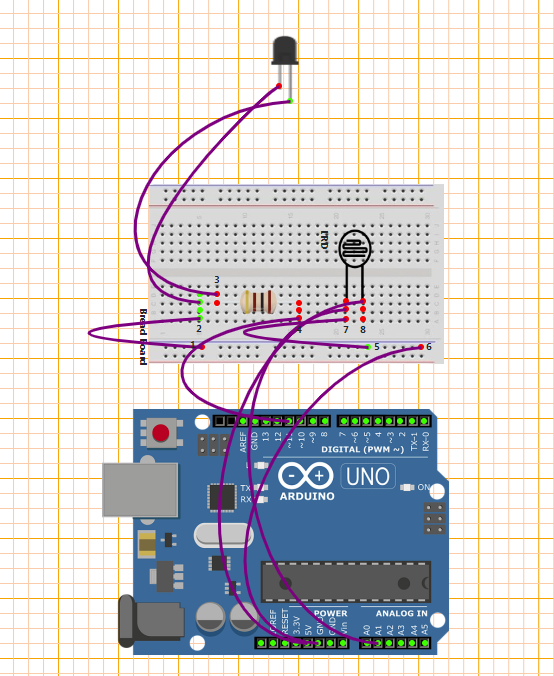
Working of the Circuit:
1. Variable Declaration:
- ldrPin is defined to specify the analog pin connected to the LDR.
- ledPin is defined to specify the digital pin connected to the LED.
- sensorValue is declared to store the analog value read from the LDR.
2. In the Setup Function:
• pinMode(ldrPin, INPUT);
configures the ldrPin as an input pin to read the analog voltage from the LDR.
• pinMode(ledPin, OUTPUT);
configures the ledPin as an output pin to control the LED.
• Serial.begin(9600);
initializes serial communication with a baud rate of 9600, enabling communication with the serial monitor.
3. In the Loop Function:
• sensorValue = analogRead(ldrPin);
reads the analog voltage from the LDR and stores it in sensorValue.
• delay(sensorValue);
introduces a delay based on the analog value read from the LDR. Higher analog values (more light) result in longer delays.
• int brightness = map(sensorValue, 0, 1023, 0, 255);
maps the sensor value from the range of 0 to 1023 (ADC range) to the range of 0 to 255 (PWM range) to control the brightness of the LED.
• Serial.println(brightness);
prints the brightness value to the serial monitor for debugging purposes.
• analogWrite(ledPin, brightness);
sets the brightness of the LED using PWM (Pulse Width Modulation) based on the mapped sensor value.
• delay(100);
introduces a small delay for stability.
Therefore, in this experiment, the brightness of the LED is controlled based on the light intensity detected by the LDR. More light detected by the LDR results in higher brightness of the LED, and vice versa.