
Theory
Arduino UNO
The Arduino Uno is a widely acclaimed microcontroller board, renowned for its open-source ethos and intuitive design. Serving as a gateway to boundless possibilities in electronics and programming, it caters to novices and experts alike. At its heart lies the Microchip ATmega328P microcontroller, orchestrating tasks from sensor readings to motor control. With 14 digital and 6 analog input/output pins, it offers versatility for a plethora of projects. Programmable through the Arduino IDE, it simplifies coding with its user-friendly interface and simplified C++ variant. Its adaptability extends across various applications, from environmental monitoring to robotics. Standardized form factor facilitates integration with expansion boards, or "shields," enabling effortless augmentation of functionalities. In essence, the Arduino Uno empowers enthusiasts to materialize their ideas swiftly and seamlessly in the realm of electronics and beyond.
.png)
Light Emitting Diode(LED)
LEDs, or Light-Emitting Diodes, are semiconductor devices that emit light when an electric current passes through them, a phenomenon known as electroluminescence. Composed of semiconductor materials like gallium arsenide or gallium nitride, LEDs offer energy-efficient illumination across a spectrum of colors due to the engineering of their band gap. The process of recombination of electrons and electron holes within the semiconductor material releases energy in the form of photons, generating light. LEDs are structured with an anode and a cathode to facilitate uni-directional current flow and ensure reliable operation. Their energy efficiency, long lifespan, and instant brightness make them superior to traditional lighting technologies. Furthermore, LEDs are available in various colors, with each color determined by the specific semiconductor material used. Overall, LEDs represent a significant advancement in lighting technology, offering unparalleled efficiency and versatility in numerous applications.
Applications of LED:
1. Lighting:
LEDs are extensively used for lighting purposes in residential, commercial, and industrial settings. They illuminate homes, offices, streets, and stadiums, providing energy-efficient alternatives to traditional incandescent and fluorescent lighting. LED streetlights offer bright and uniform illumination while reducing energy consumption and maintenance costs. In architectural lighting, LEDs allow for creative and dynamic lighting designs, enhancing the ambiance of buildings and public spaces.
2. Display and Signage:
LEDs power digital displays, billboards, and signage due to their high brightness, vivid colors, and long lifespan. LED displays are visible even in bright sunlight, making them ideal for outdoor advertising and information dissemination. In indoor settings, LED screens provide sharp and vibrant images for applications such as digital signage, scoreboards, and information kiosks.
3. Automotive Lighting:
LEDs have become standard in automotive lighting systems, including headlights, taillights, brake lights, and interior lighting. They offer superior brightness, instant response time, and energy efficiency compared to traditional halogen bulbs. LED headlights provide better visibility and safety on the road, while LED brake lights enhance driver awareness and response time.
4. Consumer Electronics:
LEDs are ubiquitous in consumer electronics, from smartphones and TVs to laptops and gaming consoles. They backlight LCD screens, illuminate keyboards, and indicate device status. In home appliances, LEDs are used in refrigerators, ovens, and washing machines for interior lighting and control panel displays.
5. Horticulture and Agriculture:
LED grow lights are increasingly used in horticulture and agriculture for indoor farming, greenhouse cultivation, and vertical farming. These lights provide specific wavelengths of light optimized for plant growth, promoting photosynthesis and improving crop yield and quality. LED grow lights are also energy-efficient and produce less heat, reducing the need for cooling systems.
6. Medical and Scientific Applications:
LEDs are employed in medical devices, diagnostic equipment, and scientific instruments for various applications. They are used in phototherapy for treating skin conditions, dental curing lights for dental procedures, and fluorescence microscopy for imaging biological samples. LEDs also serve as light sources in spectrophotometers, photometers, and analytical instruments.
7. Aviation and Aerospace:
LEDs are increasingly used in aviation and aerospace applications for aircraft lighting, cockpit displays, and navigation systems. LED aircraft lights offer improved visibility, reduced power consumption, and longer lifespan compared to traditional incandescent lights. In space exploration, LEDs are used in spacecraft lighting, cameras, and sensors due to their reliability and compact size.
Potentiometer
What is a Potentiometer?
A potentiometer, commonly known as a "pot," is a three-terminal resistor with a sliding or rotating contact that forms an adjustable voltage divider. Its operation is based on a resistive element that extends along its length, with a movable contact, or wiper, that taps off a portion of the applied voltage. By adjusting the position of the wiper, the resistance between the wiper terminal and the fixed terminals can be varied, enabling precise control over the output voltage. Potentiometers find wide application in electronics, serving as key components in volume controls, brightness adjustments, motor speed regulation, and tuning/calibration systems.
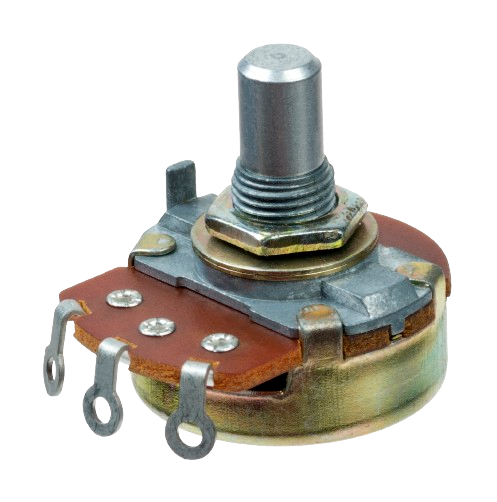
Working of potentiometer
Working of potentiometer lies at a simple yet ingenious principle: the manipulation of resistance to control voltage output. Comprising a resistive element and a movable contact, or wiper, the potentiometer facilitates precise adjustments in electrical circuits. As the wiper glides along the resistive element's surface, it varies the distance between itself and the fixed terminals, altering the path for electric current flow. This adjustment changes the resistance between the wiper terminal and the other two terminals, consequently modifying the voltage output. By leveraging this mechanism, potentiometers serve a myriad of functions across diverse applications. For instance, in audio devices, they regulate volume by adjusting the resistance in the circuit, modulating the intensity of sound output. Similarly, in displays, potentiometers control brightness levels, fine-tuning the luminosity of screens for optimal visibility. Moreover, in motor controls, potentiometers govern speed by regulating the voltage supplied to motors, enabling precise adjustments in rotational velocity. Ultimately, the versatile operation of potentiometers underscores their indispensability in achieving tailored control and functionality across a wide spectrum of electronic systems and devices.
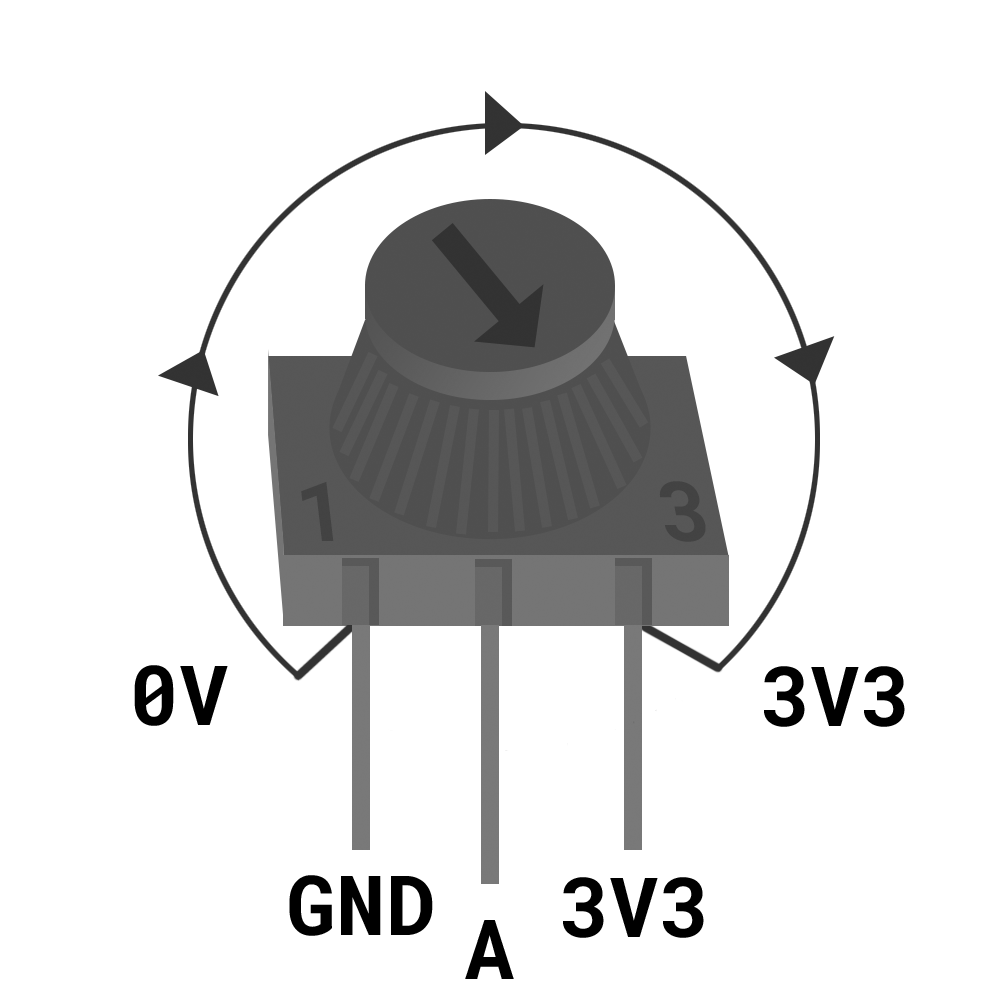
Types of Potentiometers:
Potentiometers come in various types, each tailored to specific applications to ensure optimal performance and functionality. Here's an in-depth look at the different types:
1. Linear Potentiometers: Linear potentiometers have a consistent, linear relationship between the position of the wiper and the resistance along the resistive element. This means that as the wiper moves linearly along the track, the resistance changes proportionally. Linear potentiometers are commonly used in applications where a direct, linear relationship between the control input and the output signal is desired. One prominent example is volume knobs in audio equipment, where users expect a linear increase or decrease in volume with the rotation of the knob.
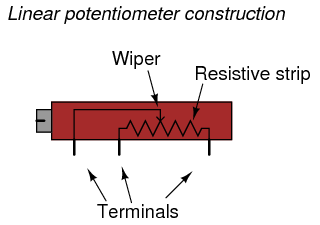
2. Logarithmic Potentiometers (Log Pots): Logarithmic potentiometers, also known as "log pots" or "audio taper" pots, feature a logarithmic taper that mimics the logarithmic response of the human ear to changes in volume. In other words, the resistance changes logarithmically with the position of the wiper, providing a more natural and intuitive control over audio volume. Logarithmic potentiometers are widely used in audio applications, such as amplifiers, mixing consoles, and musical instruments, where achieving smooth and perceptually balanced volume control is essential.
3. Multi-turn Potentiometers: Multi-turn potentiometers offer finer control over resistance by requiring multiple rotations to cover their full range. Unlike standard potentiometers that typically require only a single rotation, multi-turn potentiometers allow users to make precise adjustments with greater resolution. This makes them ideal for applications that demand high precision, such as instrumentation, calibration equipment, and scientific instruments. By requiring multiple rotations, multi-turn potentiometers enable users to make incremental changes with accuracy, ensuring precise control over the circuit parameters.
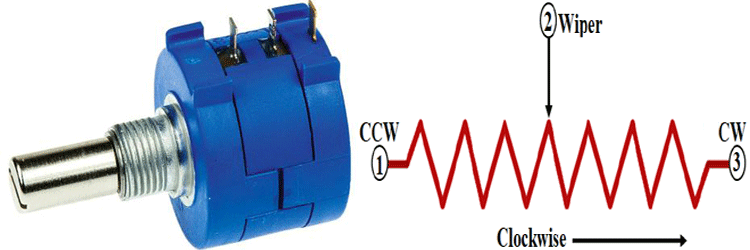
Applications of Potentiometer:
Potentiometers, with their versatility and precision control capabilities, are integral components in various industries and applications. Let's explore how potentiometers are utilized in different fields:
1. Audio Equipment:
Potentiometers play a crucial role in audio equipment, offering control over volume, tone, and equalization. In audio systems such as amplifiers, stereos, and mixing consoles, potentiometers are used as volume knobs to adjust the output sound level. Additionally, they are employed in tone control circuits to adjust bass, treble, and midrange frequencies, allowing users to tailor the audio output to their preferences. Equalizers, which adjust the relative levels of different frequency bands, also rely on potentiometers for fine-tuning audio signals to achieve desired sound quality.
2. Instrumentation:
In instrumentation and measurement devices, potentiometers serve as calibration controls for fine adjustments. Precision potentiometers are used in calibration equipment to set reference values and calibrate instruments accurately. For example, in electronic meters, oscilloscopes, and signal generators, potentiometers are employed to calibrate voltage, frequency, and amplitude settings, ensuring accurate measurements and reliable performance.
3. Control Systems:
Potentiometers are essential components in control systems for regulating various parameters such as motor speed, light intensity, and temperature. In motor speed control applications, potentiometers are used to adjust the voltage supplied to the motor, thereby controlling its speed and torque. Light dimmers utilize potentiometers to vary the resistance in the circuit, adjusting the brightness of lamps or LED lights. Similarly, in temperature control systems, potentiometers are employed to set desired temperature levels by adjusting the resistance in temperature control circuits, thereby regulating heating or cooling elements.
4. User Interfaces:
Potentiometers are commonly used in user interfaces to provide intuitive control in electronic devices. They are incorporated into joysticks, sliders, and knobs to facilitate user interaction with electronic systems. Joysticks in gaming consoles and remote-controlled devices use potentiometers to detect the position of the joystick and translate it into directional commands. Sliders and knobs in audio mixers, synthesizers, and electronic instruments use potentiometers to adjust parameters such as volume, pitch, and modulation. Additionally, potentiometers are utilized in automotive dashboard controls, household appliances, and industrial machinery interfaces to enable users to adjust settings and parameters easily.
Circuit for LED blink rate with the potentiometer interfacing with Arduino :
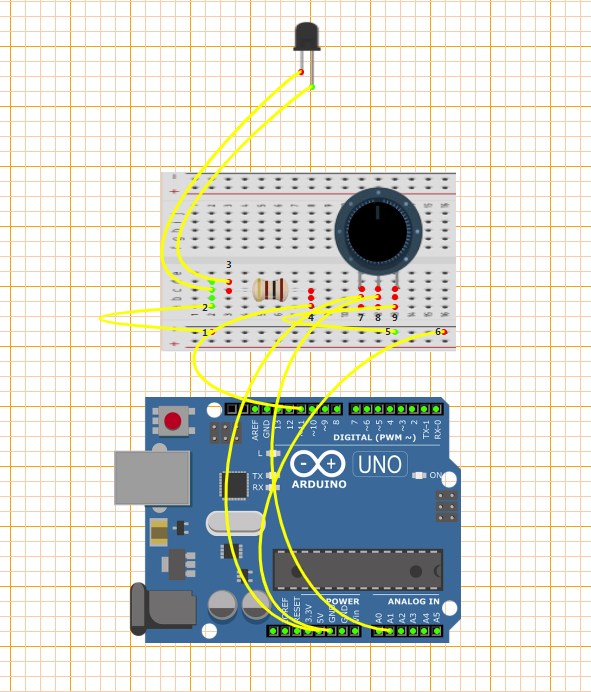
Working of the Circuit
1. In the setup() function:
• pinMode(ledPin, OUTPUT);
configures the ledPin as an output pin to which the LED is connected.
• val = analogRead(potPin);
reads the analog value from the potentiometer connected to potPin. The analogRead() function returns a value between 0 and 1023 representing the voltage level at the pin.
2. In the loop() function:
• digitalWrite(ledPin, HIGH);
turns on the LED by setting the ledPin to a HIGH (5V) state.
• delay(val);
causes the Arduino to pause for a duration determined by the value read from the potentiometer. This duration determines how long the LED remains on.
• digitalWrite(ledPin, LOW);
turns off the LED by setting the ledPin to a LOW (0V) state.
• delay(val);
causes another delay for the same duration as before, determining how long the LED remains off.
• Serial.println(val);
prints the potentiometer reading to the serial monitor, allowing us to observe the changes in the potentiometer value.
Therefore, as the potentiometer knob is adjusted, the LED blinking frequency alters in direct correlation to the potentiometer's position. When the potentiometer value increases, indicating a higher position of the knob, the LED remains illuminated for a longer duration during each cycle and stays off for an extended period as well. Consequently, the LED exhibits a slower blinking rate. Conversely, when the potentiometer value decreases, indicating a lower position of the knob, the LED blinks more rapidly, with shorter intervals of both on and off states. Thus, the potentiometer acts as a control mechanism, regulating the LED's blinking frequency based on the user's adjustment, offering a dynamic and customizable lighting effect.