
Theory
The Wien's bridge is an AC electrical circuit widely used for measuring frequency and capacitance with high accuracy. The bridge can be used even at high voltages but the circuit is sensitive to frequency. The Wien Robinson bridge has a series and parallel combination of R-C.
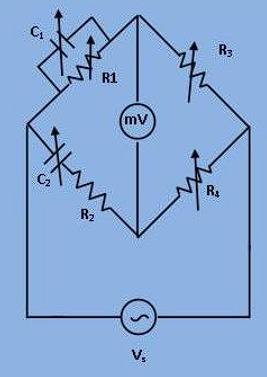
A balance detector or null indicator is connected across two junctions (i.e., across BD as shown above). The indicator shows null deflection when the bridge is balanced, i.e., when the junctions B and D will be at the same potential.
Let \( C_1 \) be the capacitor connected in parallel to resistance \( R_1 \), \( C_2 \) be a standard capacitance with series resistance \( R_2 \), and \( R_2 \) and \( R_3 \) be non-inductive resistances. It is a ratio real type bridge, for balance we have,
\(\frac{{R_4}}{{R_3}} = \frac{{R_2}}{{R_1}} + \frac{{C_1}}{{C_2}} + j(\omega C_1R_2-(1/C_2R_2))....(1)\)
\(\omega = \frac{{1}}{{\sqrt{{R_1R_2C_1C_2}}}}\)
then, \( f = \frac{{1}}{{2\pi\sqrt{{R_1R_2C_1C_2}}}}\)