
Introduction
Supercapacitors bridge the gap between traditional capacitors and batteries, offering rapid charge/discharge and ultra-long cycle life via purely electrostatic (electric double layer) and electrochemical (pseudocapacitance) mechanisms. In contrast, batteries store energy chemically within electrode materials, yielding much higher energy density but slower dynamics. Comparing them provides insight into combining fast-response power supply (via the supercapacitor) with longer-duration energy storage (via the battery).
Working Principle:
- Charge both sources to their respective voltages.
- Apply a dynamic load profile (e.g., pulsed demand) via converters.
- Supercapacitor responds instantaneously, delivering large bursts, while battery supplies sustained power.
- Measure voltages (V), currents (I), and compute power (P = V·I) over time for both devices.
- Analyze State of Charge (SOC), power contribution, and total energy profile.
Theoretical Background:
- Supercapacitor Fundamentals
- Energy storage formula: W = ½ C V2
- Combines double-layer capacitance (electrostatic) and pseudocapacitance (surface redox)
- Key traits: high power density, low energy density, rapid dynamics, and long cycle life (100,000–1,000,000 cycles)
- Battery Fundamentals
- Stores energy via electrochemical reactions in electrode materials (e.g., lithium intercalation).
- Offers high energy density (up to ~650 Wh/L for Li‑ion)
- Slower charge/discharge, limited cycle life (hundreds to thousands of cycles).
- Comparative Metrics The Ragone plot effectively visualizes the trade‑off:
- Supercapacitor high power, low energy;
- Battery low power, high energy
- Performance is quantified via power density, energy density, efficiency, self‑discharge, and lifetime.
Graphs & Their Interpretation
- Battery Metrics Over Time:Observe warm voltage, moderate current, SOC declining gradually.
- Supercapacitor Metrics Over Time:Characterized by sharp voltage-current spikes during load pulses, rapid current surges/decays.
- Power Comparison (Battery vs SC):SC dominates during transient spikes; battery holds steady between pulses.
- Total Power:Summed contributions, showing sustained plus pulsed load coverage without sag.
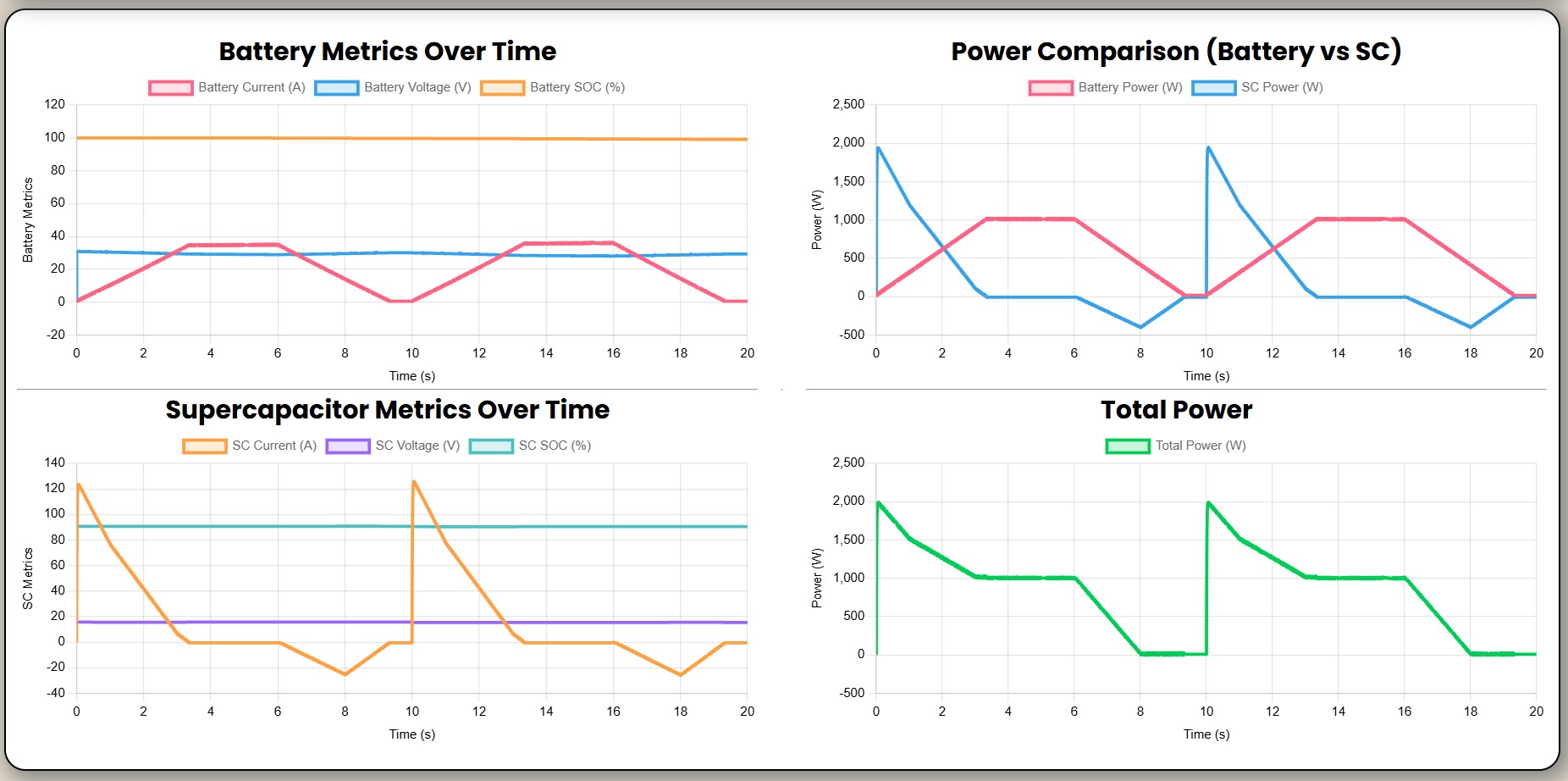
Fig. 1 Output Waveforms
Advantages & Disadvantages
| Device | Advantages | Disadvantages |
|---|---|---|
| Supercapacitor |
|
|
| Battery |
|
|
Conclusion:
- Synergistic use: Supercapacitors offer burst power, batteries provide sustained energy—together achieving optimal performance.
- Practical outcome: In hybrid systems, SC handles transients while battery smooths baseline load.
- Experimentally, this supports long-term stability, improved efficiency, and reduced battery strain.
- Future direction: developing hybrid devices (e.g., “supercapatteries”) to merge both strengths