
Introduction
A Permanent Magnet Synchronous Motor (PMSM) is a type of AC synchronous motor where the rotor’s magnetic field is established by permanent magnets instead of electromagnetic windings. This results in a sinusoidal back electromotive force (EMF) and ensures high efficiency and dynamic performance.
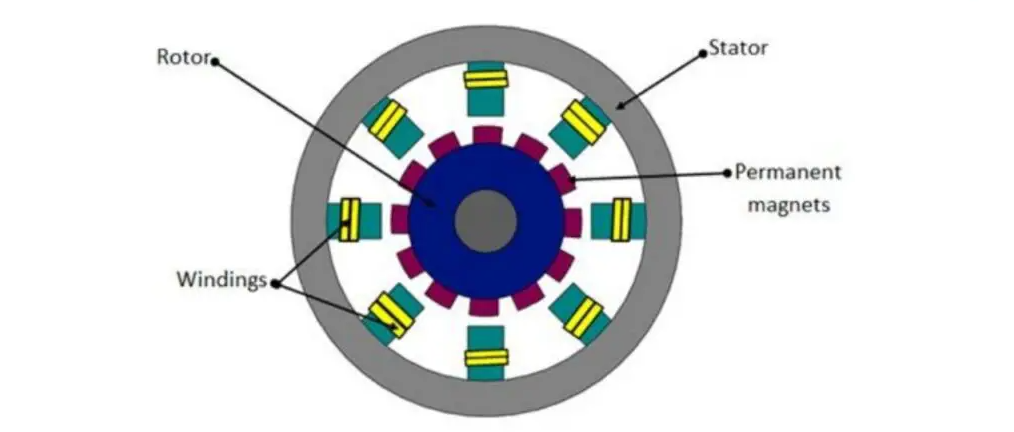
fig.1 : PMSM Motor
Working Principle
The PMSM operates based on the interaction between the rotating magnetic field of the stator and the fixed magnetic field of the rotor. When a three-phase AC supply is given to the stator, it generates a rotating magnetic field. The rotor, containing permanent magnets, aligns with this field and rotates synchronously with the supply frequency. Unlike induction motors, PMSMs are not self-starting and require external electronic control to initiate rotation.
Key Equations
EMF Equation
The EMF equation depends on the coils and the conductors on the stator. For this motor, distribution factor Kd and pitch factor Kp is also considered.
Hence,
E = 4 × Φf × Tph × Kd × Kp
- Φ = Flux per pole (Weber)
- f = Frequency (Hz)
- Tph = Turns per phase
- Kd = Distribution factor
- Kp = Pitch factor
Torque Equation
The torque equation of a permanent magnet synchronous motor is given as,
T = (3 × Eph × Iph × sin β) / ωm
- Eph = EMF per phase
- Iph = Current per phase
- β = Torque angle
- ωm = Angular speed (rad/sec)
Current vs Load Characteristics of PMSM
As the load on the motor increases, it compensates by drawing more current while maintaining a constant voltage and speed. Initially, from load 0 to 4, the graph exhibits a linear trend. However, as the load increases beyond this point, there is a sudden surge in current up to load 5. Between loads 5 and 8, the graph transitions into a curved pattern, and beyond this range, the graph breaks, indicating a critical threshold.
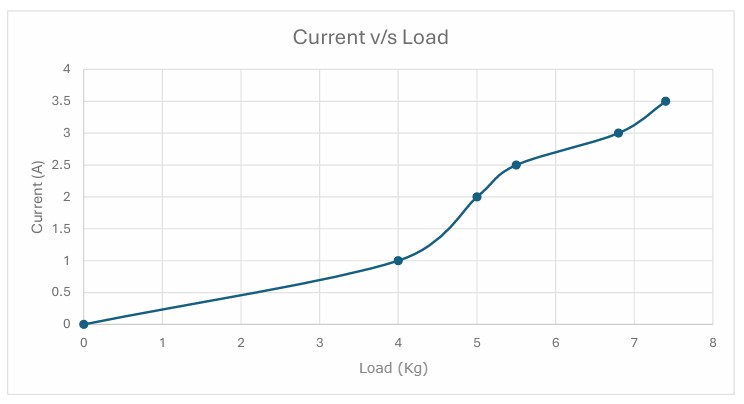
fig.2 : Current (A) vs Load (Kg)
Advantages of PMSM
- High Efficiency: Delivers better efficiency at high speeds.
- Compact Size: Available in smaller sizes for various applications.
- Easy Maintenance: No field winding reduces maintenance.
- Full Torque at Low Speed: Provides stable torque across different speeds.
Disadvantages of PMSM
- Expensive: Higher cost than induction motors.
- Not Self-Starting: Requires an external controller to initiate rotation.
Performance Analysis
The PMSM maintains a constant speed regardless of load variations due to its synchronous nature. However, as observed in the experiment:
Conclusion
Permanent Magnet Synchronous Motors are highly efficient and reliable, making them suitable for applications requiring precise control and high performance. However, their higher cost and the need for electronic control for startup are important considerations when selecting these motors for specific applications. Understanding their operational principles and electromagnetic characteristics is crucial for optimizing their performance and ensuring efficient operation.