
Theory
Ohm's Law
- The law states that the current through a conductor between two points is directly proportional to the voltage across the two points. Such a conductor is characterized by its ‘Resistance’ – R measured in Ohms.
- V = I × R
- V is the Voltage in Volts across the conductor.
- I is the current in Amperes through the conductor.
- Voltage(V) is directly proportional to current i.e
V = I × R - Resistance(R) in inversely proportional to current(I) i.e
I = V / R
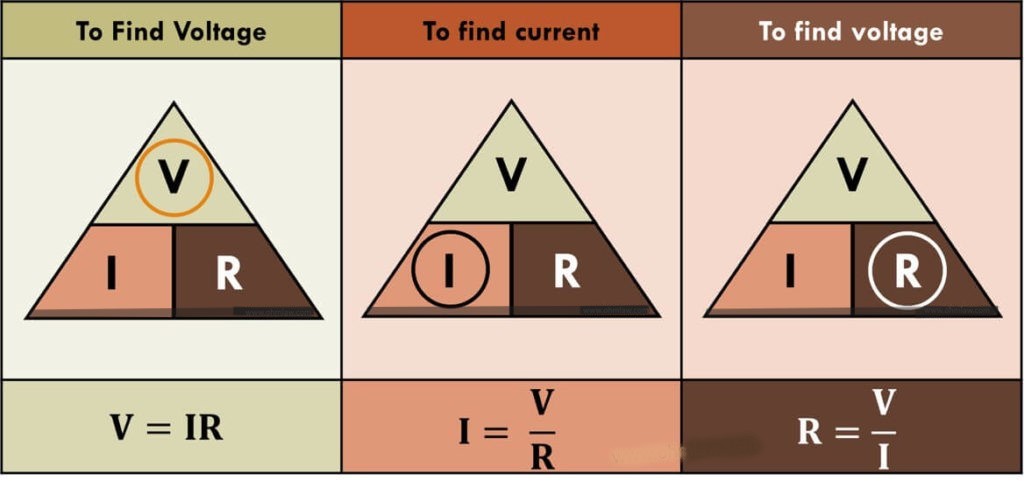
NOTE:
From the above figure, the equation may be represented by a triangle known as Ohm's Law triangle,
where V (voltage) is placed on the top section, the I (current) is placed to the left section,
and the R (resistance) is placed to the right.
The line that divides the left and right sections indicates multiplication,
and the divider between the top and bottom sections indicates division.
Therefore equations derived from Ohm's law triangle are-
V = I × R
I = V / R
R = V / I