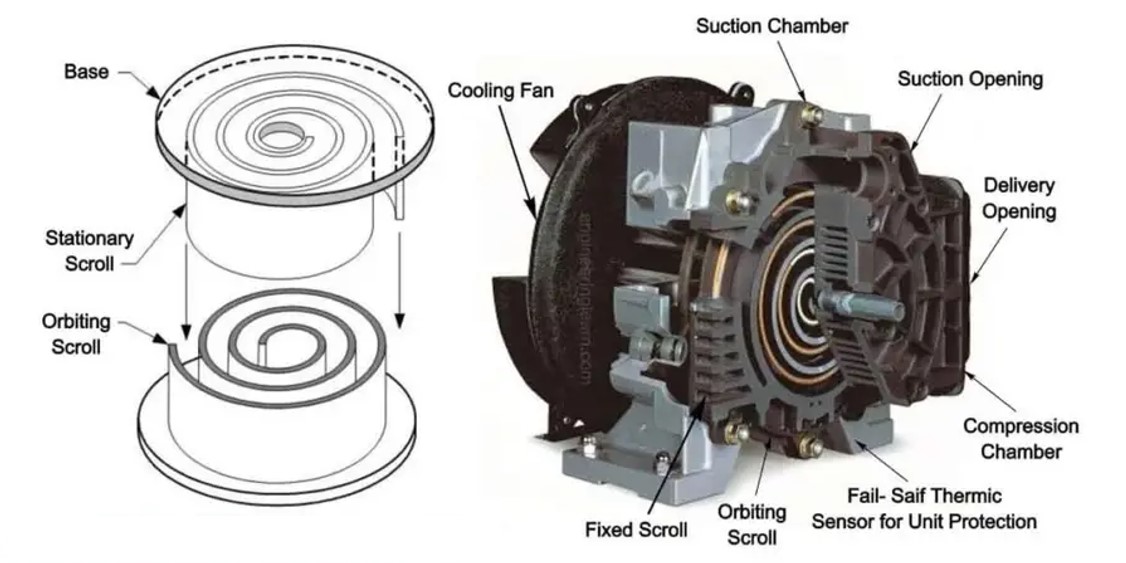
1. Scroll Compressor
Scroll Compressors, also referred to as spiral compressors, have been sophisticated and commercialized since the 1980s. These feature the radial movement across mating parts that help the lower the mechanical stress. Furthermore, it also plays an important role in optimizing the contact force when even the smallest particle will get into the compressors. Even when there is a liquid slug, it will be swept off from the mating components. The vaporization from the scroll compressor will increase but will also have a certain tolerance level for the liquid. The scroll compressors follow a centrifugal force when they are operating.
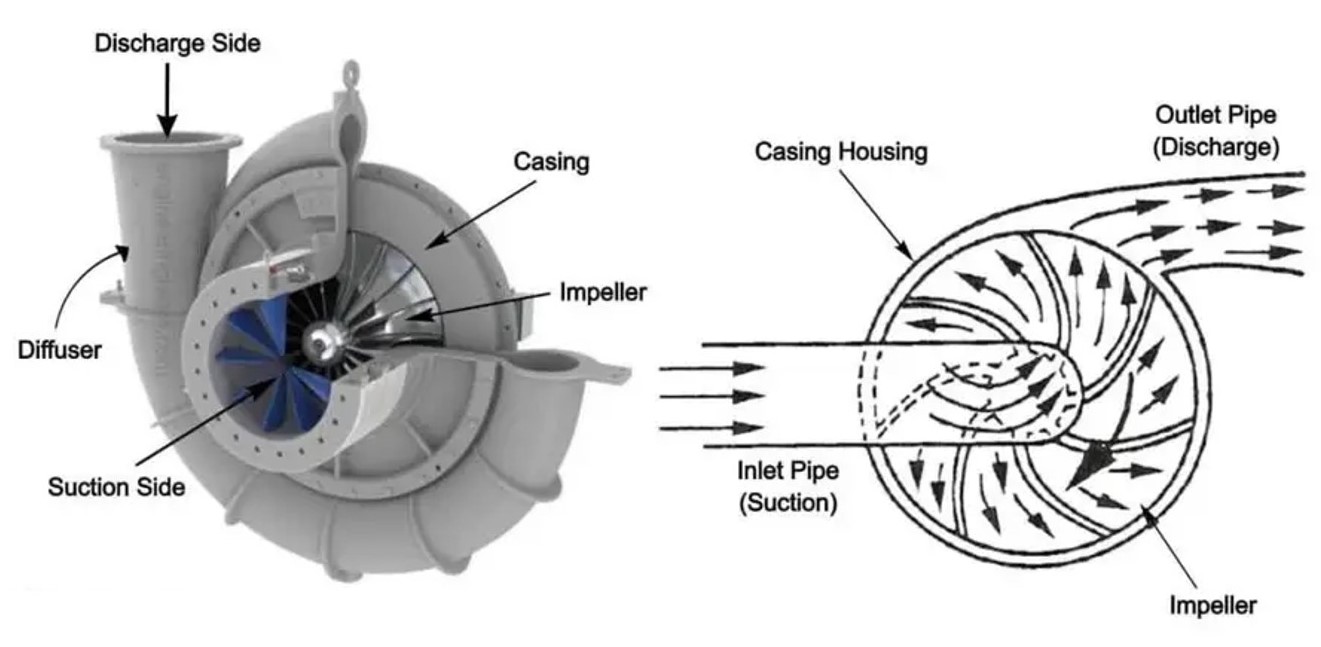
2. Centrifugal Compressor
The Centrifugal compressors are also referred to as radial or turbo compressors. These pressurize the refrigerant as they force the refrigerant via a rotating impeller. The impeller will spin the refrigerant as the speed gradually increases. The increase in speed will further increase kinetic energy. The kinetic energy generated throughout will further pressurize the refrigerant to pass via a diffuser. This will eventually lead to slowing the radial movement of the vapour. When the radial vapour movement slows down, the converted kinetic energy of the refrigerant will turn into potential energy. The potential energy will further be present as the pressure format.
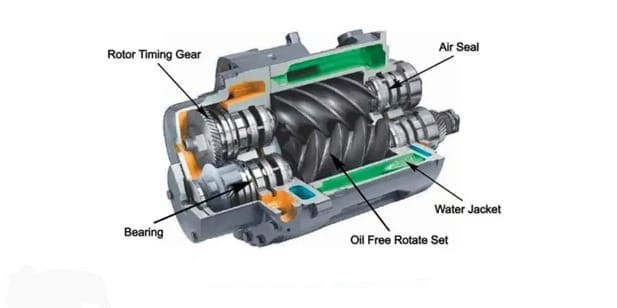
3. Rotary Screw Compressor
The rotary screw compressors have two meshed rotors which work together but rotate in opposite directions. In a rotary screw compressor, the refrigerant enters from the suction port. After entering, the refrigerant gets trapped between the rotating rotors. When the air travels through the rotor, the space volume between the two elements will reduce, eventually allowing the refrigerant to be compressed. Unlike other compressors, screw compressors do not have valves or use mechanical force. This plays an important role in the high-speed operation of rotary screw compressors. Comparatively, these have a smaller footprint with higher flow rates. As a result, these rotary screw compressors have reduced or lesser vibration.
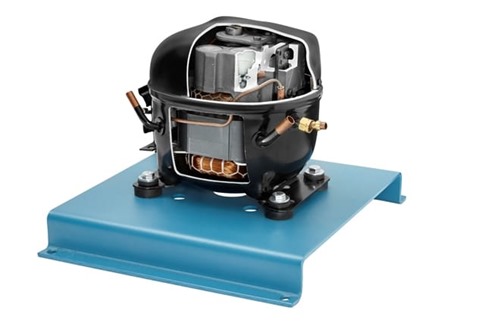
4. Reciprocating Compressor
The reciprocating compressors have the same design as that of a combustion engine. The individual cylinders of the same will contain two to six pistons. All these pistons have a central crankshaft. The piston will move downward, and the refrigerant will be sucked inside the cylinder via an inlet valve. The inlet valve will close when the piston moves back in the upward direction. The volume of the space within the cylinder will also decrease, thereby compressing the refrigerant. After a certain point of time, the refrigerant will become compressed. It will need a sufficient amount of force to open the discharge valve. The refrigerant will exit and promote the cycle to be repeated.
Working of Compressor
A compressor works by increasing the pressure of a gas, typically by reducing its volume. This is achieved by using a mechanical device to decrease the space occupied by the gas, forcing its molecules closer together and thus increasing its pressure. Compressors are commonly used in various applications, including air conditioning systems, refrigeration, and industrial processes
Applications of Compressor
In refrigeration systems, compressors play a central role in the refrigeration cycle by compressing
the refrigerant vapor to increase its pressure and temperature. This process enables the refrigerant
to release heat absorbed from the refrigerated space and transfer it to the surroundings, resulting
in the cooling effect. Here's how compressors are specifically utilized in refrigeration systems:
1. Compression of Refrigerant: The primary function of the compressor in a refrigeration system
is to
compress the low-pressure refrigerant vapor coming from the evaporator. This compression increases
the pressure and temperature of the refrigerant, preparing it for the next stage of the
refrigeration cycle.
2. Creation of Pressure Difference: By compressing the refrigerant vapor, the compressor creates
a
pressure difference between the evaporator (where the refrigerant absorbs heat) and the condenser
(where the refrigerant releases Reciprocating Compressor heat). This pressure difference drives the
flow of refrigerant through the system.
3. Temperature Increase: As the refrigerant vapor is compressed, its temperature rises
significantly
due to the compression process itself. This hightemperature, high-pressure refrigerant vapor is then
directed to the condenser.
4. Transfer of Heat: The high-temperature, high-pressure refrigerant vapor enters the condenser
coil,
where it releases heat to the surrounding air or water. this causes the refrigerant to condense into
a liquid state while transferring the heat absorbed from the refrigerated space to the external
environment.
5. Efficiency and Performance: The efficiency and performance of a refrigeration system largely
depend on the compressor's capacity to compress the refrigerant efficiently. Proper compressor
selection and operation are essential to ensure optimal cooling performance and energy efficiency.
6. Types of Compressors: Different types of compressors are used in refrigeration systems,
including
reciprocating, scroll, rotary screw, and centrifugal compressors. Each type has its advantages and
is selected based on factors such as cooling capacity, efficiency, noise level, and application
requirements.
7. Control and Regulation: Compressors in refrigeration systems are often equipped with control
mechanisms to regulate their operation based on factors such as temperature, pressure, and system
load. This ensures that the compressor operates efficiently under varying conditions and helps
maintain optimal cooling performance.
Advantages of Compressor
1. Increased Efficiency: Compressors can increase the efficiency of various processes by reducing
the
volume of gases or fluids, allowing for easier transportation or storage.
2. Energy Savings: They enable the compression of air or gases, which can be utilized in various
applications such as powering pneumatic tools or processes, leading to energy savings compared to
alternative methods.
3. Versatility: Compressors are versatile and can be used in a wide range of industries and
applications, including manufacturing, construction, refrigeration, and healthcare.
4. Space Saving: They help save space by reducing the volume of gases or fluids,making storage
and
transportation more manageable and efficient.
5. Control:Compressors offer precise control over the pressure and flow rate of gases or fluids,
allowing for tailored applications to meet specific needs.
6. Reliability: Modern compressors are engineered for reliability and durability, providing
consistent performance over time with minimal maintenance requirements.
7. Environmental Benefits:In some cases, compressors can contribute to environmental benefits by
reducing emissions or enabling more efficient use of resources.