Components
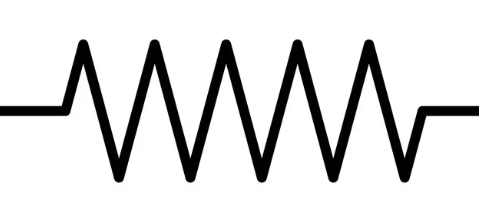
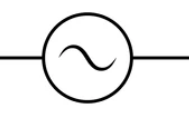

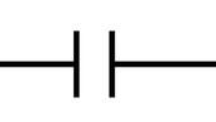
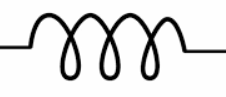
Formulae
If Bridge is Balanced:
There will be no potencial difference across the terminal of the sound-sensor.Current through the sound-sensor: 0
` C_1=frac(C_2R_4)(R_3)`
`R_1=frac(R_3C_4)(C_2)`
If Bridge is Unbalanced:
There will be some potencial difference across the terminal of the speaker.
Hence, some current will flow through the speaker and it's effect can be heared.
WorkSpace
Owen's Bridge Experiment :
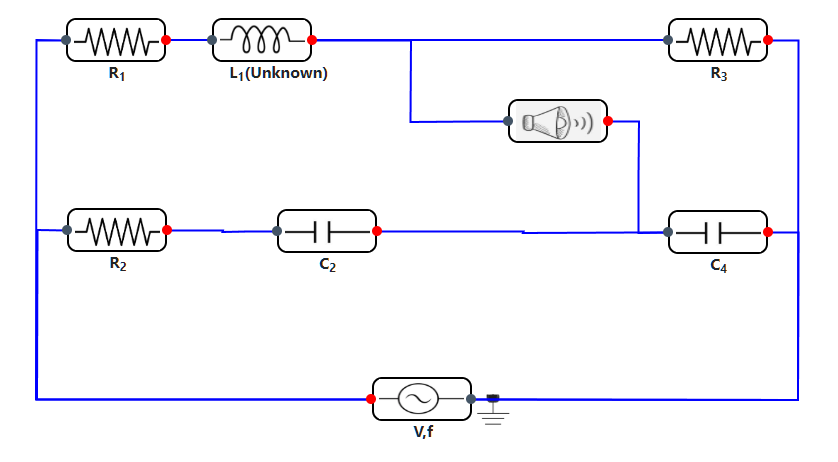
- •Pick up resistances, capacitor, inductor, ac source and speaker from the toolbox.
- •Make connections as shown in the figure to form a Owen's bridge (red dot act as source and black dot act as destination).
- •After making the circuit click on check circuit button to check the connections.
- •Select value of capacitor and resistance R3.Now Enter value of source-voltage (in Volt), voltage-frequency(in Hz) and choose appropriate value of R2(in Ω) through slider and click on the submit button.
- •Repeat the experiment untill the bridge gets balanced.
close
Close
Schering Bridge Experiment:
If Bridge is Balanced:
There will be no potencial difference across the terminal of the sound-sensorCurrent through the sound-sensor: 0 Amp
`Z_1=R_1+jomegaL_1`
`Z_2=R_2+frac(1)(jomegaC_2)`
`Z_3=R_3`
`Z_4=frac(1)(jomegaC_4)`
` Z_(1)Z_4=Z_2Z_3`
Now we need to substitute the impedence value's of Owen's bridge in the above equation
Then
`(R_1+jomegaL_1)(frac(1)(jomegaC_4))=(R_2+frac(1)(jomegaC_2))R_3`
Now we need to equate the real and imaginary terms of the above equations
We get,
` L_1=R_2R_3C_4`
`R_1=frac(R_3C_4)(C_2)`
If Bridge is Unbalanced:
There will be some potencial difference across the terminal of the speaker.
Hence, some current will flow through the speaker and it's effect can be heared.
Calculations
Voltage across detector:
--.--
R1=1kΩ
, C4=1 μF
Observation Table
| `R_1` in(Ω) | `L_1` in(mH) | `C_2` in(μF) | `R_2` in(Ω) | `V` in(volt) | `f_r` in(Hz) |
|---|